
Commercial Heating, Ventilation, and Air Conditioning (HVAC) systems are among the largest electrical consumers in modern commercial buildings, hospitals, pharmaceutical facilities, data centres, and industrial manufacturing plants. Modern HVAC infrastructure—ranging from screw and centrifugal chillers to Variable Refrigerant Flow (VRF/VRV) systems and Air Handling Units (AHUs)—relies on high-efficiency, microprocessor-governed compressor motors and electronic inverter drives.
However, power grids across India and many developing industrial corridors suffer from severe voltage sags, surges, brownouts, and phase unbalance. Because HVAC compressors operate continuously under high thermal and mechanical stress, even moderate electrical anomalies can trigger catastrophic compressor burnouts, inverter drive trips, and expensive facility downtime.
In this comprehensive engineering guide, we explore why 3-phase servo voltage stabilizers are indispensable for commercial HVAC systems, how to accurately calculate stabilizer kVA capacity from Tons of Refrigeration (TR), and the critical protection features required for compressor longevity.
Why HVAC Systems Are Highly Vulnerable to Voltage Fluctuation
HVAC compressors are induction or permanent-magnet motors operating against high refrigerant head pressures. Unlike standard resistive loads, electrical instability impacts them in three distinct and destructive ways:
flowchart TD
  grid["⚡ Indian Grid Fluctuation
(340V - 480V, Phase Unbalance)"]

  grid --> sag["📉 Voltage Sag / Brownout
(Under-Voltage <380V)"]
  grid --> unbal["⚖️ Voltage Unbalance
(Phase-to-Phase Voltage Asymmetry)"]
  grid --> surge["📈 Voltage Surge / Spike
(Over-Voltage >440V)"]

  sag --> c1["Compressor motor draws excess current
(I = P / √3 × V × cosφ)"]
  c1 --> heat1["Excessive I²R thermal buildup
→ Thermal Overload Trip & Insulation Breakdown"]

  unbal --> c2["Negative Sequence Current Generated
(1% Voltage Unbalance = 6-10% Current Unbalance)"]
  c2 --> heat2["Localized Stator Hotspots
→ Catastrophic Compressor Motor Burnout"]

  surge --> c3["VFD DC-Bus Over-voltage
PCB Control Board Semiconductor Puncture"]

  heat1 & heat2 & c3 --> fail["💸 Premature Compressor Replacement
+ Massive Facility Downtime"]
  fail --> sol["✅ Solution: ServoKai 3-Phase Servo Voltage Stabilizer
(415V ±1% Balanced Pure Copper Regulation)"]

  style sol fill:#1152D4,stroke:#0B1628,stroke-width:2px,color:#fff
1. The Multiplier Effect of Voltage Unbalance
In a 3-phase electrical supply, if the voltages between phases differ by just 2% to 3%, the resulting negative-sequence magnetic fields inside the compressor motor generate severe counter-torque and current unbalance of 15% to 25%. This produces localized overheating in the motor windings, rapidly degrading Class F/H insulation and causing inter-turn short circuits.
2. Under-Voltage and High Current Draw (Thermal Overload)
When utility voltage drops during peak summer demand, the compressor motor must draw proportionally higher current (amperes) to deliver the same mechanical tonnage ($P = \sqrt3 \times V \times I \times \cos\phi$). The heating effect inside the motor increases exponentially with the square of current ($I^2R$). Continuous operation at under-voltage leads to repeated thermal overload tripping, oil breakdown, and eventual seizure of scroll/screw compressor assemblies.
3. VFD and Inverter Inrush Vulnerability
Modern VRF/VRV outdoor units and variable-speed chillers utilize Variable Frequency Drives (VFDs). Voltage transients and harmonic distortion cause the internal DC-bus capacitors and IGBT modules of the inverter to trip on over-voltage or under-voltage faults, locking out climate control across entire floors.
How a 3-Phase Servo Stabilizer Protects HVAC Infrastructure
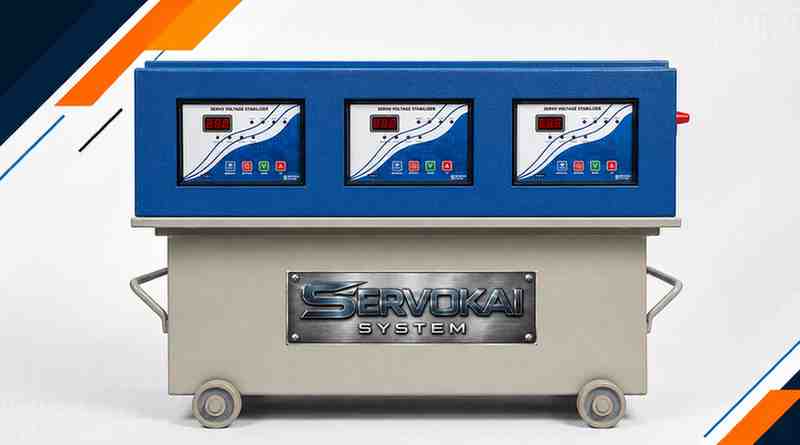
A servo-controlled voltage stabilizer actively monitors the incoming three-phase supply and corrects phase-to-phase and phase-to-neutral voltages in real time using a precision microcontroller, motorized toroidal autotransformer (variac), and heavy-duty buck-boost transformer.
Critical Engineering Advantages:
- True RMS Step-Less Regulation (415V ±1%): Continuously delivers steady, balanced voltage to all three phases regardless of grid fluctuations.
- Independent Phase Correction (Unbalanced Load Support): Corrects each phase independently, eliminating voltage asymmetry between lines even if one phase experiences a severe local sag.
- Zero Waveform Distortion (Nil Added THD): Unlike static SCR-based voltage controllers, a servo stabilizer maintains a pure sine wave, ensuring smooth motor rotation without introducing harmonic noise.
- 100% Electrolytic Copper Winding: ServoKai stabilizers utilize Class H insulated electrolytic copper conductors capable of handling heavy continuous industrial duty and high starting inrushes without thermal degradation.
Sizing Chart: How to Calculate Stabilizer kVA for HVAC & Chillers
Selecting the correct stabilizer capacity requires accounting for compressor starting current (Locked Rotor Amps or LRA), motor efficiency, power factor, and whether the system uses Direct-On-Line (DOL), Star-Delta, Soft Starter, or Variable Frequency Drive (VFD) starting.
HVAC Capacity to Servo Stabilizer Sizing Matrix
| HVAC Equipment Type | Typical Rating (TR / HP) | Connected Electrical Load (kW) | Recommended Starting Method | Recommended Servo Stabilizer Capacity (kVA) |
|---|---|---|---|---|
| Ductable Split AC Unit | 5.5 TR (~7.5 HP) | 6.5 kW | DOL / Inverter | 15 kVA – 20 kVA (3-Phase) |
| Packaged Rooftop Unit | 10 TR (~15 HP) | 12.0 kW | Star-Delta | 30 kVA (3-Phase) |
| VRF / VRV Outdoor Unit | 16 HP (~14 TR) | 14.5 kW | Inverter / VFD | 30 kVA – 40 kVA (3-Phase) |
| Commercial VRF Modular Bank | 32 HP (~28 TR) | 29.0 kW | Inverter / VFD | 60 kVA – 75 kVA (3-Phase) |
| Air-Cooled Scroll Chiller | 30 TR (~40 HP) | 36.0 kW | Soft Starter / VFD | 75 kVA – 100 kVA (3-Phase) |
| Air-Cooled Screw Chiller | 60 TR (~80 HP) | 72.0 kW | Star-Delta / Soft Starter | 150 kVA – 200 kVA (3-Phase) |
| Central Water-Cooled Chiller | 100 TR (~130 HP) | 115.0 kW | Soft Starter / VFD | 250 kVA – 300 kVA (3-Phase) |
| Large Industrial Chiller Plant | 200 TR (~260 HP) | 230.0 kW | VFD Driven Centrifugal | 500 kVA – 600 kVA (3-Phase) |
Rule of Thumb for HVAC Sizing:
For direct fixed-speed chillers (Star-Delta / DOL), size the servo stabilizer at 2.0× to 2.5× the running kW load to accommodate starting current inrush. For modern VFD/Inverter-driven chillers and VRF systems, size the stabilizer at 1.3× to 1.5× the rated full-load kVA.
Air Cooled vs Oil Cooled: Which Stabilizer is Best for HVAC?
| Feature / Criteria | Air Cooled Servo Stabilizer | Oil Cooled Servo Stabilizer |
|---|---|---|
| Recommended HVAC Capacity | 10 kVA to 40 kVA | 40 kVA to 2000 kVA |
| Ideal Installation Location | Indoor AHU rooms, basement electrical shafts, rooftop enclosed plant rooms | Outdoor chiller yards, open terraces, substations, industrial plant floors |
| Cooling Medium | Forced cooling fans / Natural air circulation | High-dielectric Transformer Oil (IS 335) with corrugated cooling radiators |
| Dust & Humidity Resistance | Moderate (requires filter cleaning in dusty environments) | Exceptional (Hermetically sealed tank protects coils from corrosion, moisture, and ambient heat) |
| Duty Cycle | 16–20 Hours/Day | 24/7/365 Continuous Heavy Industrial Duty |
| Footprint & Maintenance | Compact footprint, dry maintenance | Slightly larger footprint, oil level inspection annually |
For central chiller plants, rooftop condenser units, and industrial facilities, Oil Cooled Three Phase Servo Voltage Stabilizers are universally recommended due to their superior heat dissipation under continuous 45°C–50°C Indian summer ambient temperatures.
Mandatory Protection Features for HVAC Voltage Stabilizers
When procuring a servo stabilizer for HVAC infrastructure, ensure the specification sheet includes these critical protective interlocks:
- Electronic Time Delay Relay (ETDR):
After a grid power interruption or trip, the stabilizer must enforce a 3 to 5-minute restart delay before feeding power to the compressor. This allows high-pressure refrigerant gas to equalize across the suction and discharge lines, preventing locked-rotor stalling on restart. - Single Phasing & Phase Reversal Preventer:
If one utility phase drops out or utility technicians reverse phase sequences during grid maintenance, the controller instantly isolates the HVAC load within milliseconds to prevent 3-phase compressor motors from running in single-phase or reverse rotation. - High & Low Voltage Cut-Off:
Automatically disconnects output if incoming voltage falls outside the safe operating envelope (e.g., below 300V or above 480V in wide-range models). - Electronic Overload & Short Circuit Trip:
Protects the stabilizer and downstream distribution panel with high-rupture capacity MCCB/MCB protection. - Manual / Automatic Maintenance Bypass Switch:
Allows routine inspection and service of the stabilizer without turning off the building’s central air conditioning.
Real-World Applications
- Multi-Speciality Hospitals & OT Complexes: Maintaining continuous 415V power to clean-room AHUs, HEPA filtration chillers, and MRI chiller loops where cooling failure risks patient safety.
- Commercial IT Parks & Data Centres: Protecting precision air conditioning (PAC) and computer room air handling (CRAH) units against voltage fluctuations that could overheat server racks.
- Hotels & Hospitality Chains: Ensuring silent, seamless operation of central VRF and water-cooled chiller plants without flickering or AC tripping during guest peak hours.
- Cold Storage & Food Processing: Preventing compressor failure and temperature rise in ammonia and Freon refrigeration systems preserving perishable inventory.
Frequently Asked Questions (HVAC Voltage Stabilization)
Q1: Can I connect my building’s entire HVAC chiller plant to a single central servo stabilizer?
Yes. Centralized oil-cooled servo stabilizers (rated from 100 kVA to 1000+ kVA) are routinely installed at the main HVAC distribution board (LT panel), stabilizing the entire cooling plant including chillers, primary/secondary chilled water pumps, condenser pumps, and cooling tower fans.
Q2: Why does my VRF outdoor unit frequently show error codes (e.g., E4 / P4 / Under-Voltage) during summer afternoons?
During peak summer hours, heavy grid load causes utility voltage to drop below 360V (line-to-line). Inverter VRF controllers detect this brownout and trigger self-protective error codes to prevent compressor drive overheating. Installing a 3-phase servo stabilizer with a wide input window (e.g., 300V–480V) permanently resolves these summer nuisance trips.
Q3: What is the warranty and lifespan of a ServoKai industrial servo stabilizer for HVAC?
ServoKai HVAC servo stabilizers are manufactured with 100% pure electrolytic copper winding and heavy-duty transformer tanks, engineered for an operational lifespan exceeding 15 to 20 years. Every unit includes a 1-Year Comprehensive On-Site Manufacturer Warranty backed by direct factory technician support across India.
Consult with ServoKai Power Conditioning Engineers
Need assistance sizing the exact stabilizer capacity for your commercial chiller, VRF system, or factory HVAC infrastructure? Contact ServoKai’s senior engineering team for technical datasheets and factory-direct proposals:
- Direct Factory Calling Line (Primary): +91-8383001512
- Secondary Technical Line: +91-9873405780
- WhatsApp Inquiries: Chat Directly on WhatsApp
- Sales & Engineering Email: sales@servokaisystem.com
- Manufacturing Plant: 246/63, East School Block, I.P Extn., Mandawali Fazalpur, Delhi 110092, India